TracePro for defense electro-optical systems: stray light, Narcissus and baffle analysis
Updated September 21, 2026
Defense and aerospace electro-optical systems must maintain image quality when unwanted light enters from outside the intended field of view or originates inside the instrument. TracePro from Lambda Research Corporation gives optical and opto-mechanical engineers a non-sequential ray-tracing environment for analyzing stray light, ghost paths, scattering, diffraction, self-emission and baffle performance in the full system model. OSLO Premium supports the sequential lens-design stage, while TracePro extends the analysis to mechanical geometry, sources, detectors and unwanted paths.
Stray light analysis for electro-optical systems
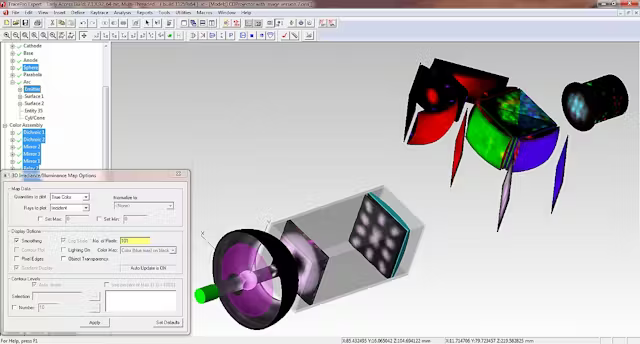
Stray light can reduce contrast, obscure a weak target or add unwanted signal at a detector. In TracePro, engineers can model the optical and mechanical geometry together, apply source and surface properties, trace rays through the assembled system and inspect the paths that reach a detector.
The analysis can include unwanted reflections, scatter from optical or mechanical surfaces, aperture and edge diffraction, ghost paths and thermal self-emission. Ray path sorting helps identify which surfaces and interactions contribute to detector irradiance. Engineers can then test changes to coatings, surface properties, apertures and mechanical geometry before committing to hardware.
For a broader overview of these methods, see Comprehensive stray light analysis with TracePro.
Baffle design and off-axis source control
A baffle must block or redirect unwanted light without clipping the required field of view. TracePro lets engineers model candidate baffle geometry within the opto-mechanical assembly, illuminate the system from relevant off-axis angles and examine the rays that reach the detector.
This workflow can be used to compare baffle positions, lengths, apertures and surface treatments. The resulting ray histories show whether energy reached the detector through a direct path, a specular reflection or a scattering event. That evidence gives the design team a practical basis for refining the baffle and other internal structures.
The existing TracePro stray light analysis data sheet remains a useful companion resource for Monte Carlo ray tracing, ray path sorting and CAD import.
Infrared systems and Narcissus analysis
In a cooled infrared imaging system, the detector can see a reflected image of itself or other cold structures. This Narcissus effect can create nonuniform signal and interfere with image interpretation. TracePro includes Narcissus analysis among its supported applications and can model detector-related paths alongside stray light, ghost reflections and thermal self-emission.
Engineers can use the system model to identify surfaces that return detector or cold-shield energy toward the focal plane, examine the responsible paths and test changes to geometry, coatings or surface properties. The same model can be used to study thermal contributions from optical and mechanical components at infrared wavelengths.
Worked examples and technical references
- Stray light cross-checks of the James Webb Space Telescope shows a published space-telescope stray-light application listed in Lambda Research's TracePro reference literature.
- Narcissus analysis for a cooled staring infrared system provides a focused published example of Narcissus analysis for an infrared detector system.
- Stray radiation analysis of an infrared detecting system provides a second infrared worked example centered on unwanted radiation reaching the detector.
These examples are technical references, not claims that Lambda Research designed the instruments described in each paper.
How TracePro and OSLO Premium fit together
Defense electro-optical development often moves from lens design to analysis of the assembled instrument. OSLO Premium is used for sequential lens design, optimization and imaging analysis. The optical prescription can then support a TracePro model that includes mechanical structures, baffles, sources, detectors and non-sequential paths.
TracePro is the primary product for the system-level stray light, baffle and Narcissus work described on this page. OSLO Premium is included here only for the sequential lens-design stage. This distinction replaces the current page's broad treatment of both products as interchangeable tools.
Frequently asked questions
What is stray light in a defense electro-optical system?
Stray light is optical energy that reaches the detector through an unintended path. It can come from off-axis sources, reflections, surface or bulk scatter, diffraction, ghost paths or thermal self-emission. Its effects can include lower contrast, veiling glare and unwanted detector signal.
How does TracePro support baffle design?
TracePro models baffles with the rest of the optical and mechanical assembly. Engineers can trace relevant off-axis sources, inspect the paths that reach the detector and compare changes to baffle geometry and surface properties before hardware is built.
What is the Narcissus effect in an infrared system?
The Narcissus effect occurs when a cooled infrared detector sees a reflected image of itself or another cold structure. The resulting nonuniform signal can interfere with the scene image. TracePro can be used to identify the paths responsible and evaluate design changes intended to reduce the effect.
Can TracePro analyze ghost reflections and scattering?
Yes. TracePro supports analysis of ghost paths, scattering, diffraction and self-emission in non-sequential optical and opto-mechanical models. Ray path sorting helps engineers isolate the interactions that contribute energy at a detector.
Can TracePro use mechanical CAD geometry?
Yes. TracePro supports CAD import so the optical and mechanical parts of an electro-optical system can be evaluated in one model. This is useful when housings, mounts, apertures and baffles affect unwanted light paths.
When should a team use OSLO Premium with TracePro?
Use OSLO Premium for sequential lens design, optimization and imaging analysis. Use TracePro for non-sequential analysis of the assembled system, including stray light, baffles, ghost paths, scattering, self-emission and Narcissus effects.
Does TracePro replace physical testing?
No. Simulation helps teams find risks, compare design changes and refine test plans before hardware is available. Qualification and acceptance testing remain necessary for the finished system.
Evaluate stray light, baffle performance and detector-related paths in your electro-optical system before committing to hardware. Request a TracePro demonstration or contact the Lambda Research support team to discuss your application.
Other TracePro Applications
Automotive
Automotive solutions for analyzing, simulating, and optimizing vehicle systems
Solar Power
Solar Power solutions for analyzing, simulating, and optimizing energy systems
Consumer Electronics
Consumer Electronics solutions for analyzing, simulating, and optimizing electronic devices