
The complex interaction of light with biological tissue forms the foundation of numerous medical and biophotonic technologies, spanning from advanced optical imaging and targeted phototherapy to precision laser surgery and sophisticated diagnostic systems. Understanding the intricate mechanisms governing how light behaves as it enters and propagates through diverse biological media—including skin, muscle, blood vessels, and internal organs—is absolutely essential for designing devices that deliver accurate, safe, and clinically effective optical performance.
TracePro, a sophisticated non-sequential ray tracing software platform, provides an exceptionally powerful framework for modeling these complex light-tissue interactions with unprecedented accuracy. While biological media are inherently highly scattering and strongly absorbing, TracePro's advanced capabilities enable researchers to simulate realistic tissue geometries, wavelength-dependent optical properties, and diverse light source configurations to comprehensively analyze how optical energy distributes, attenuates, and interacts within the human body.
The Critical Importance of Tissue Simulation in Biomedical Optics
Biological tissues present unique optical challenges as they are inherently inhomogeneous, exhibit strong wavelength-dependent scattering characteristics, and demonstrate complex absorption patterns that vary significantly with tissue type, hydration state, and physiological condition. Unlike optically clear media such as precision lenses or ambient air, biological tissues introduce extraordinarily complex light behavior that makes accurate propagation prediction virtually impossible without sophisticated computational simulation.
Precise modeling capabilities allow for comprehensive device optimization before expensive clinical trials or prototype fabrication phases. This simulation-driven approach helps answer fundamental questions critical to biomedical device development: How deep will therapeutic light penetrate into target tissues? What proportion of incident optical energy successfully reaches the intended treatment layer? How much potentially harmful heat is generated during treatment? What precise dosage is delivered in photodynamic therapy applications?
Without access to accurate simulation tools, these crucial questions are typically answered through inefficient and potentially risky trial-and-error methodologies—an approach that is both time-consuming and potentially dangerous in biomedical engineering applications. TracePro effectively fills this critical gap by providing detailed insight into internal light dynamics within complex biological media, helping reduce development time while simultaneously improving treatment safety and therapeutic effectiveness.
TracePro's Comprehensive Capabilities in Biomedical Modeling
- Advanced Simulation Engine for Complex Media
TracePro is a CAD-integrated, non-sequential ray tracing software platform built to handle intricate light behavior in three-dimensional structures. Its ability to simulate absorption, scattering, and transmission within complex biological systems makes it ideal for biomedical optics, where traditional ray tracing methods fall short. - Importing and Defining Anatomical Models
Detailed tissue structures can be brought into TracePro as layered geometric models or voxel-based CAD representations that mirror actual anatomical complexity. Each region or layer can be assigned wavelength-dependent absorption and scattering coefficients, as well as anisotropy factors that define directional scattering patterns unique to each tissue type. - Flexible Light Source Configuration
TracePro supports multiple light source types, from experimentally measured angular distributions to simplified representations like point sources and collimated emitters. These sources can be tailored for specific applications such as diagnostic imaging, therapeutic delivery, or optical sensing within biological media. - Robust Analytical Capabilities
The software enables precise evaluation of fluence rate maps, energy deposition zones, and stray light propagation. These insights are critical for optimizing medical devices that interact with tissue, ensuring both safety and performance in demanding clinical environments.
Defining Accurate Tissue Optical Properties
Biological tissues exhibit highly unique optical behavior that depends critically on cellular structure, pigmentation levels, hydration status, and complex cellular composition. TracePro supports comprehensive material definitions incorporating key parameters including absorption coefficient (μa), which determines the precise amount of light absorbed per millimeter of tissue traversal; scattering coefficient (μs), which defines the statistical probability of scattering events within tissue; anisotropy factor (g), which captures the directional characteristics of forward- or backward-scattered light; and refractive index values that affect refraction and reflection at tissue boundaries.
These critical optical parameters can be systematically assigned to individual tissue layers representing distinct anatomical structures such as epidermis, dermis, subcutaneous fat, muscle tissue, or specific organ tissues. By carefully adjusting these values based on extensively published biomedical literature and experimental data, simulations become highly representative of actual tissue behavior under various illumination conditions.
Advanced Light Source and Illumination Geometry Modeling
Medical devices commonly employ diverse light delivery systems including fiber optics, light-emitting diodes (LEDs), or laser diodes to deliver precisely controlled illumination into or onto biological tissue. TracePro enables users to simulate these sources with highly realistic spatial and angular emission profiles that accurately reflect actual device characteristics.
Laser sources can be modeled as narrow, highly collimated beams with specific divergence characteristics, while LED sources may be defined with Lambertian emission patterns or custom angular distributions. Light may be delivered through flat illumination panels, specialized optical diffusers, or fiber optic systems embedded directly within tissue structures. These delivery geometries prove critical for ensuring appropriate energy distribution in therapeutic procedures such as low-level light therapy (LLLT) or photodynamic therapy (PDT) applications.
Using TracePro's flexible source modeling capabilities, source positioning and illumination angles can be systematically varied to study their impact on light dose distribution, penetration depth, and treatment coverage uniformity across target tissues.
Comprehensive Multi-layer Tissue Simulation
Modeling Anatomical Tissue Layers
Layered tissue models are a standard approach in biomedical optics, used to accurately represent anatomical structures such as skin, dermis, subcutaneous fat, and muscle. In TracePro, each tissue layer is created as a distinct volume with optical properties carefully matched to experimental or literature-based data. These properties include absorption, scattering, and anisotropy, enabling realistic simulation of light-tissue interaction.
Simulating Light Propagation Through Layers
Individual light rays are traced as they pass through each tissue layer, undergoing scattering and absorption events based on the defined tissue parameters. This step-by-step interaction models how light behaves as it travels through heterogeneous biological media, offering insight into both energy loss and light redirection at each interface.
Analyzing Light Distribution and Penetration
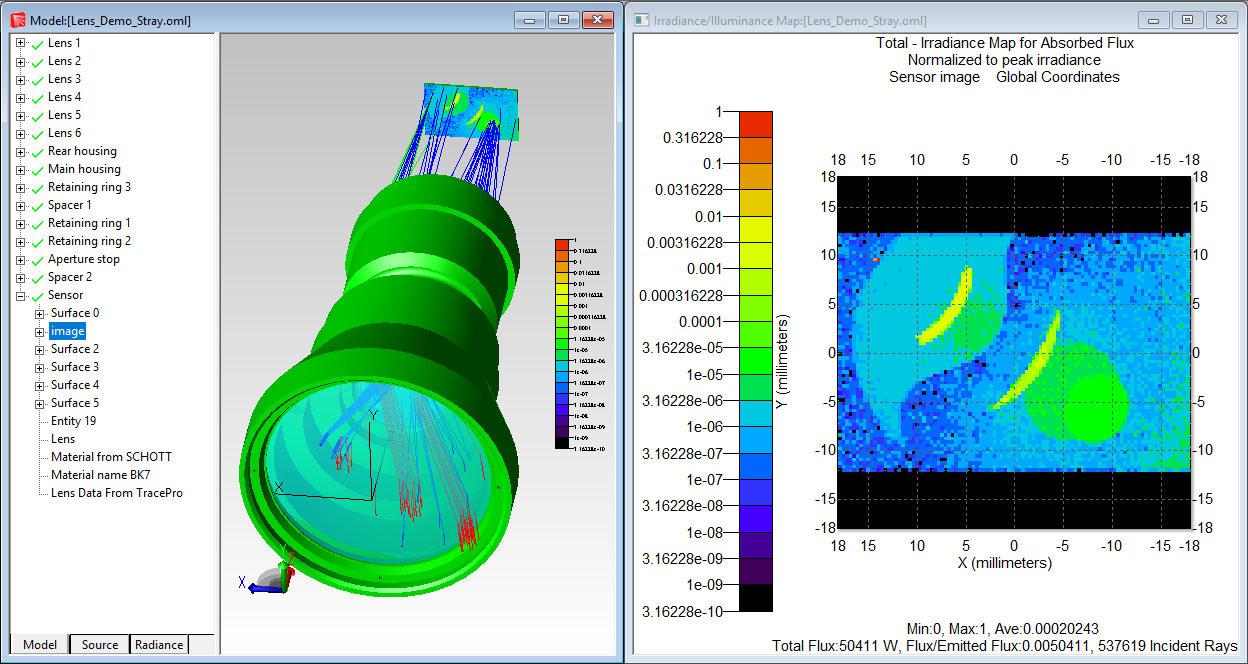
TracePro provides rich outputs such as fluence rate maps, absorbed power distributions, and complete trajectory visualizations. These results allow researchers to determine how deeply therapeutic light penetrates and where optical energy is deposited. Such detailed insights are especially critical in applications like phototherapy or tumor targeting, where accurate energy delivery to subsurface regions is essential.
Thermal Effects and Energy Deposition Analysis
In therapeutic procedures such as laser ablation or controlled hyperthermia therapy, absorbed optical energy generates significant heat that must be carefully controlled. TracePro's absorbed power analysis capabilities enable detailed thermal evaluation through:
- Irradiance maps showing where energy is concentrated.
- Total absorbed energy calculations per tissue layer.
This thermal analysis capability proves crucial for designing treatment systems that avoid dangerous overheating of sensitive tissue structures while optimizing therapeutic dosage in light-based cancer treatments and other thermal therapy applications.
Stray Light, Reflection, and Internal Scattering Analysis
In sophisticated diagnostic devices such as pulse oximeters or near-infrared spectroscopy (NIRS) probes, therapeutic light must successfully reach photodetectors after passing through complex tissue structures. However, problematic stray light, unwanted surface reflections, and unintended scattering can significantly reduce signal quality or create problematic background noise that compromises measurement accuracy.
TracePro's comprehensive ray tracking capabilities follow every ray interaction, revealing precisely where light is lost, reflected back toward the source, or scattered out of the intended optical path. These detailed simulations help optimize sensor positioning, reduce signal crosstalk, and improve signal-to-noise ratios by identifying and systematically eliminating problematic areas in the optical path design.
Practical Application: Transcutaneous Oxygen Monitoring System
Consider a sophisticated non-invasive sensor designed to monitor blood oxygen saturation by transmitting red and near-infrared light through skin tissue and detecting transmitted light with precision photodiodes. Using TracePro's comprehensive modeling capabilities, biomedical engineers construct a detailed layered skin model, define precise LED spectral output characteristics, and simulate complex light propagation through skin, blood, and muscle tissue layers.
Comprehensive simulations reveal exactly how much light successfully reaches the photodiodes, quantify absorption by oxygenated versus deoxygenated hemoglobin, and identify where stray light might reflect off device housing components. Strategic adjustments to source-detector spacing and the inclusion of optical isolators result in a significant 20% improvement in signal clarity—all achieved before producing expensive physical prototypes.
Integration into Biomedical Device Development Workflows
An efficient development workflow systematically integrates TracePro simulations throughout the complete product lifecycle: during the initial design stage, comprehensive 3D CAD models of both the device and target tissue are created; material assignment involves applying accurate optical properties based on extensive biomedical literature; simulation phases run detailed ray-tracing analyses to study energy deposition, fluence rate distributions, evaluation processes use detailed plots and maps to assess design effectiveness; and iteration cycles modify geometry, materials, or source parameters before re-running simulations.
This systematic approach enables rapid design improvements, enhances clinical safety, and reduces dependence on expensive animal or human testing during early development stages.
Advanced Applications and Future Technological Developments
Emerging applications including optogenetics, photoacoustic imaging, and bioluminescent probe technologies are pushing the boundaries of biomedical optics capabilities. TracePro continues evolving to support these advanced needs through enhanced integration with Monte Carlo solvers, expanded material databases for biological media, and sophisticated scripting tools for automated batch simulation processing.
Future capabilities may include advanced voxel-based anatomical modeling and support for dynamic tissue states such as blood perfusion changes or tissue swelling, making TracePro an even more powerful tool for next-generation biomedical device development.
From phototherapy system design to advanced diagnostics and sophisticated surgical planning, TracePro's ability to analyze complex tissue interactions helps biomedical engineers predict performance, optimize systems, and accelerate development timelines. With TracePro's comprehensive capabilities, healthcare innovators can bring more precise, safe, and effective optical devices from initial concept to clinical implementation—ultimately saving both development time and patient lives.