

Optical Instrument Design
What Is Optical Instrument Design?
Optical instrument design is the engineering discipline focused on creating systems that control, manipulate, measure, or image light. From microscopes and telescopes to LiDAR sensors, imaging systems, spectrometers, and illumination assemblies, modern optical instruments require precise modeling, performance validation, and manufacturability analysis before fabrication.
Advanced optical design software enables engineers to simulate real-world optical performance, reduce prototyping costs, and accelerate development timelines.
Optical instrument design integrates optical physics, mechanical constraints, materials science, and system-level engineering to create devices that:
- Form images
- Measure optical signals
- Deliver controlled illumination
- Detect reflected or transmitted light
- Manage stray light and scattering
- Operate reliably in real-world environments
Unlike purely theoretical optical modeling, instrument design addresses practical constraints including tolerances, thermal effects, alignment errors, manufacturability, and regulatory requirements.
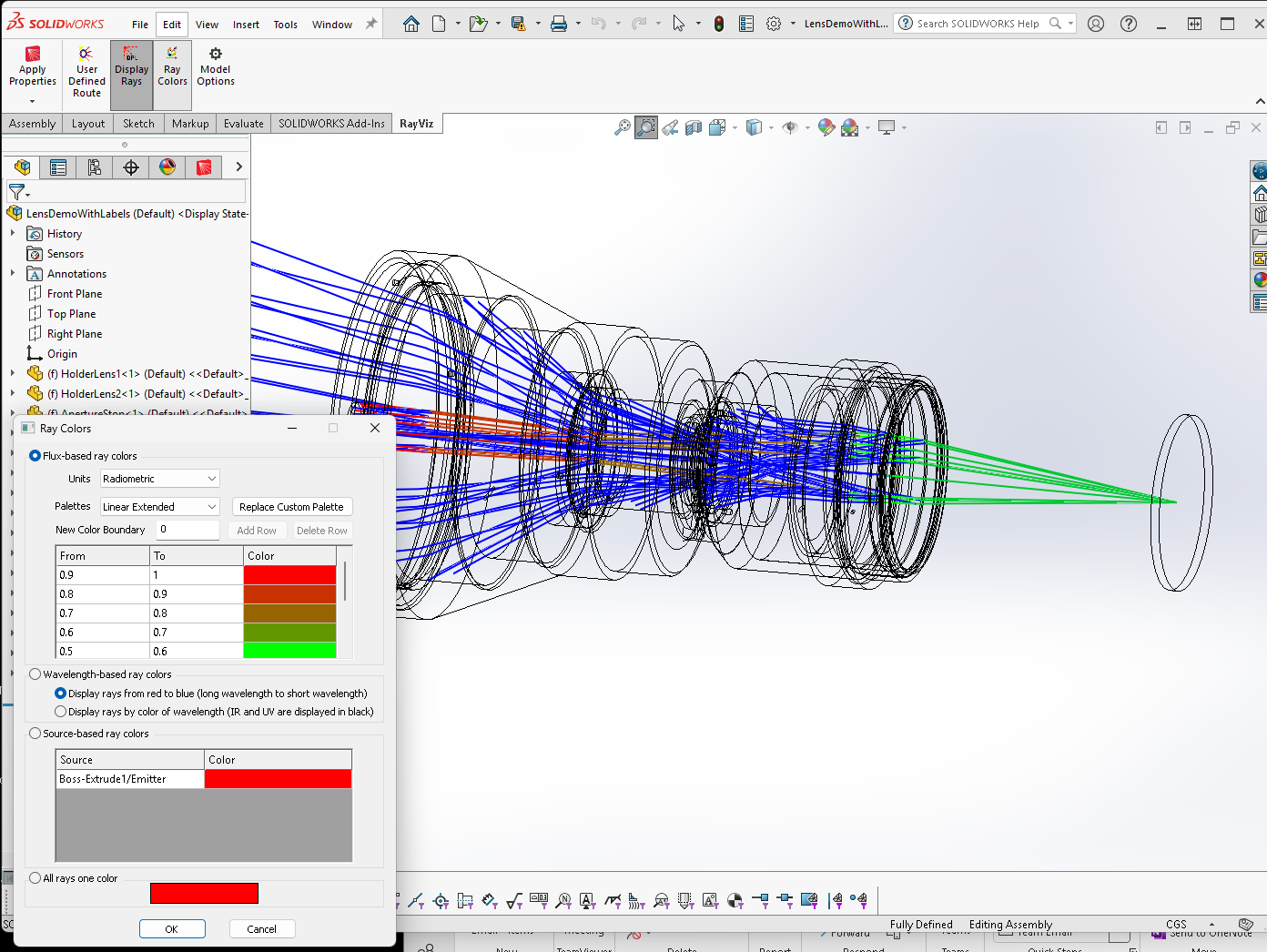
Types of Optical Instruments
- Microscopes
- Telescopes
- Industrial inspection cameras
- Medical imaging systems
These systems prioritize image quality, aberration correction, resolution, and field uniformity.
Illumination & Non-Imaging Instruments
Measurement & Sensing Instruments
- LiDAR systems
- Spectrometers
- Laser diagnostics
- Free-space optical communication systems
These require precise source modeling, detector coupling efficiency, and stray light suppression.
Core Phases of Optical Instrument Design
A complete optical instrument design workflow typically includes:
1. Concept Development & First-Order Design
Engineers define:
- System architecture
- Field of view
- Aperture size
- Wavelength range
- Detector requirements
- Mechanical envelope constraints
Sequential optical design software is often used to establish imaging performance and optimize lens configurations.
2. Detailed Optical Optimization
At this stage, designers refine:
- Aberration correction
- Spot size and MTF
- Chromatic performance
- Pupil positioning
- Distortion control
Tolerance analysis is performed to predict sensitivity to manufacturing variations.
3. Non-Sequential System Modeling
Real optical instruments are not idealized sequential systems. They include:
- Baffles
- Mechanical housings
- Surface scattering
- Coatings
- Multiple reflections
- Stray light paths
Non-sequential ray tracing is critical to evaluate real-world performance.
4. Stray Light & Ghost Analysis
Stray light can degrade instrument performance dramatically. Advanced simulation tools model:
- Surface scatter
- Bulk scatter
- Coating imperfections
- Internal reflections
- Environmental light ingress
This is particularly important in aerospace, defense, and precision measurement applications.
5. Illumination & Detector Analysis
Optical instrument design must validate:
- Irradiance distribution
- Radiometric and Photometric Efficiency
- Detector uniformity
- Signal-to-noise ratio
- Dynamic range
Monte Carlo ray tracing is frequently used for high-fidelity analysis.
Software Tools for Optical Instrument Design
Professional optical instrument design relies on integrated simulation environments.
Sequential Lens Design
Used for imaging performance optimization and aberration control.
Non-Sequential Ray Tracing
Used for real-world system modeling, stray light analysis, and illumination studies.
CAD Integration
Mechanical integration is essential. Optical software must import and interact with full 3D assemblies.
Tolerance & Manufacturability Analysis
Predicts yield and production robustness.
Modern tools such as TracePro and OSLO enable a seamless workflow from conceptual lens design through full non-sequential instrument validation.
Challenges in Modern Optical Instrument Design
Engineers must balance:
- Performance vs. cost
- Compact form factors
- Thermal stability
- Manufacturing tolerances
- Regulatory compliance
- Multi-physics integration
Software simulation significantly reduces development risk by identifying failure modes early.
Why Non-Sequential Ray Tracing?
Many optical instrument failures occur not in the idealized lens system but in:
- Housing reflections
- Surface scattering
- Aperture edge effects
- Detector overfill
- Thermal misalignment
Monte Carlo non-sequential ray tracing simulates millions of rays interacting with real geometries and material properties, providing realistic performance predictions before physical prototypes are built.
Applications of Optical Instrument Design
Industries relying on advanced optical instrument design include:
- Aerospace and defense
- Automotive sensing
- Medical devices
- Semiconductor inspection
- AR/VR display systems
- Scientific research
- Optical metrology
- Illumination engineering
As optical systems become more compact and complex, integrated modeling becomes essential.
Getting Started with Optical Instrument Design Software
When evaluating software for optical instrument design, consider:
- Sequential and non-sequential capabilities
- Monte Carlo ray tracing support
- CAD integration
- Surface and bulk scatter modeling
- Coating libraries
- Detector modeling
- Tolerance analysis
- Usability and documentation
A comprehensive toolset enables engineers to design, validate, and refine complete optical instruments within a unified environment.
Frequently Asked Questions
What is the difference between optical system design and optical instrument design?
Optical system design focuses on the optical performance of lens assemblies and light paths. Optical instrument design includes mechanical integration, stray light control, detector interaction, and environmental considerations.
Why is stray light analysis important?
Stray light reduces contrast, lowers signal-to-noise ratio, and can compromise measurement accuracy. Non-sequential simulation identifies these risks before fabrication.
What industries use optical instrument design?
Aerospace, defense, automotive, medical imaging, semiconductor inspection, AR/VR, and scientific research all rely on optical instrument design.
Design Optical Instruments with Confidence
Optical instrument design demands precision, integration, and predictive accuracy. With modern ray tracing software, engineers can simulate full optical assemblies, evaluate stray light, validate illumination, and reduce costly prototyping cycles.
Explore advanced tools for optical instrument design and accelerate your development workflow.
"TracePro’s Monte Carlo ray tracing gives us reliable illumination and stray light results in complex 3D optical models."
David Jacobsen
Director of Sales and Application Engineering